If you’re researching nicotine pouch manufacturer canada options, the first thing to understand is that this market works differently from the UK, the EU, or the US. Canada is one of the more tightly regulated nicotine pouch markets in the world, and that’s exactly why it’s worth understanding properly before trying to enter it. Health Canada made a significant regulatory move in January 2026, and the rules now on the books are clear enough that a brand can actually plan around them, rather than guessing.
We’re Microzero AB, a Swedish nicotine pouch manufacturer, and this guide covers what those rules actually mean, what’s realistic for a new brand right now, and where white label manufacturing fits into a compliant launch.
What Changed in January 2026
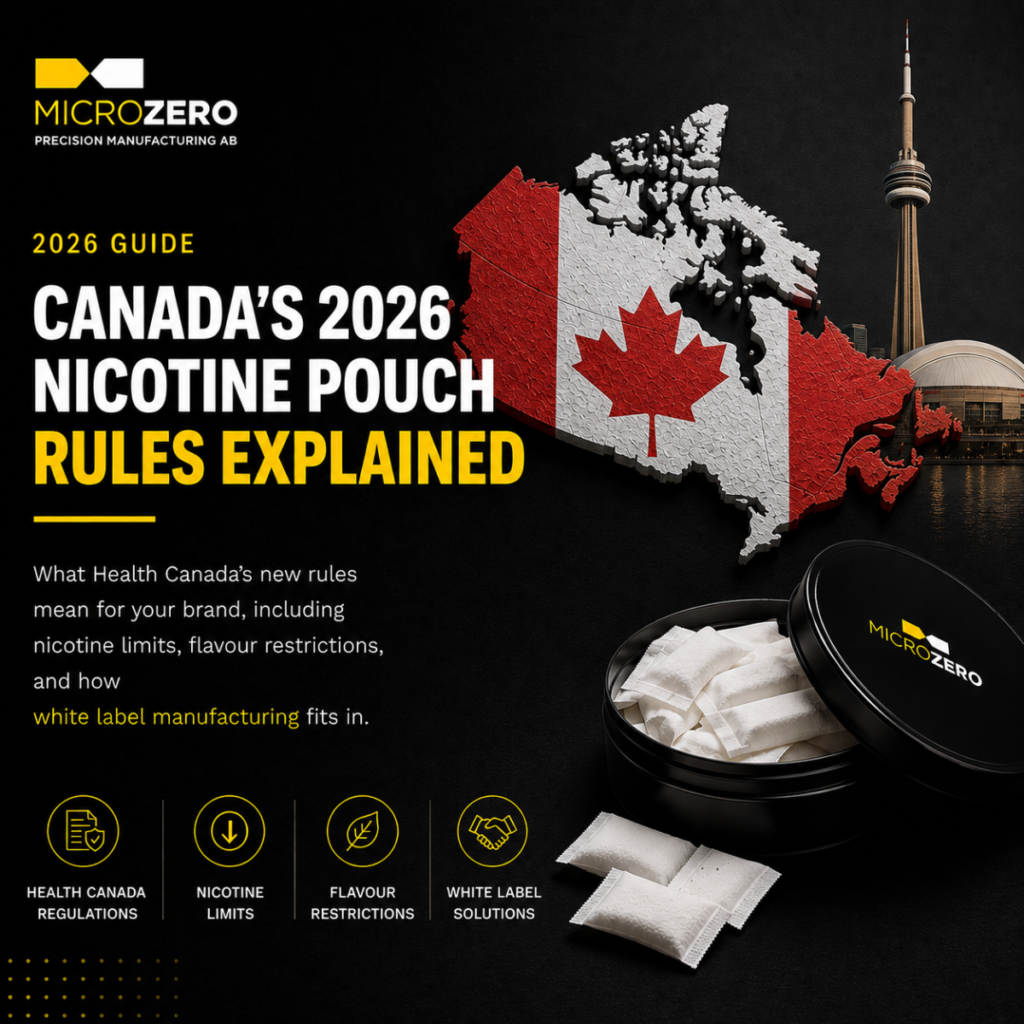
On 14 January 2026, Health Canada amended the Prescription Drug List to formally recognise low dose nicotine pouches as non prescription Natural Health Products. In practice, that means:
Pouches with 4mg of nicotine or less can be sold as Natural Health Products, provided they carry an authorised Natural Product Number and go through the Class III NHP licensing pathway.
Pouches above 4mg are classified as prescription drugs, which puts them out of reach for a standard retail launch.
Authorised products must stick to mint or menthol flavours and are sold behind the pharmacy counter to adults, not through open retail or vending.
At the moment, Zonnic is the only nicotine pouch brand that holds full Health Canada authorisation. Higher strength international brands are technically unauthorised in Canada even where they’re visible in some stores, and Health Canada has already issued recalls and public advisories on unauthorised products.
Nicotine Pouch Manufacturer Canada: Why the Timing Matters Right Now
None of this rules out entering Canada. It does mean a Canadian launch looks different from a UK or EU one, and it’s exactly why brands come to us looking for a nicotine pouch manufacturer that already understands the constraints rather than learning them mid launch. Realistically, a compliant brand needs to plan for a 4mg or lower formulation, mint or menthol flavours to start, and the NHP licensing process rather than a simple retail listing. That’s a longer runway than some other markets, but it’s also a real barrier to entry for brands that aren’t set up to handle it, which is an advantage for the ones that are.
Where the Opportunity Sits
The current market is narrow by design. With only one fully authorised brand, there’s a genuine gap for a well formulated, properly licensed product to become the second or third legitimate option on pharmacy shelves rather than competing against a crowded field. That’s a meaningfully different position than entering an already saturated market like the UK or US.
How White Label Manufacturing Fits In
Getting a product built to Canada’s specific requirements from the start, correct nicotine strength, compliant flavour profile, documentation ready for the NHP pathway, is far easier with a manufacturer who already understands the constraints, rather than adapting an existing product after the fact. We walk through formulation, MOQs, and how the white label process works more generally in our complete guide to white label nicotine pouches.
If you’re earlier in the process, our step by step guide to starting a nicotine pouch brand covers planning and production from the very beginning.
Why Brands Choose a European Manufacturer
We manufacture white nicotine pouches at our facility in Gothenburg, Sweden, along with zero pouches, caffeine pouches, energy pouches, and nootropic formats, all with full white label customization. For a market like Canada, that gives a brand a few real advantages:
Precise control over nicotine strength and formulation, so a product can be built to a specific milligram target rather than adjusted down from a stronger base formula.
A dedicated in house flavour lab, useful for developing compliant mint and menthol profiles that still stand out rather than tasting identical to the one authorised competitor.
Documented, consistent quality control that supports the kind of evidence a Class III NHP submission requires, the exact standard you’d expect from an experienced nicotine pouch manufacturer.
You can read more about how we produce them on our production page.
Canada’s Rules at a Glance
| Requirement | Detail |
|---|---|
| Maximum nicotine strength | 4mg per pouch to qualify as a Natural Health Product |
| Anything above 4mg | Classified as a prescription drug, not viable for standard retail |
| Flavour restrictions | Mint or menthol only for authorised products |
| Sales channel | Behind the pharmacy counter, adults only |
| Licensing pathway | Class III Natural Health Product, requires an NPN |
| Currently authorised brands | Zonnic only, as of this writing |
Frequently Asked Questions
Can I sell a standard 6mg or 8mg nicotine pouch in Canada?
Not through authorized retail channels. Health Canada currently caps non-prescription pouches at 4mg. Higher strengths fall under prescription drug rules, which isn’t a realistic path for a typical brand launch.
Do I need a Canadian manufacturer to get NHP authorization?
No, the manufacturer’s location isn’t the deciding factor, the product’s formulation, documentation, and safety evidence are. A manufacturer experienced in producing to specific milligram targets and documenting formulations clearly makes the licensing process considerably smoother, regardless of where they’re based.
Why are ZYN and VELO not fully authorized in Canada if they’re sold in other developed markets?
Their standard strengths (typically 6mg and above) exceed Canada’s 4mg non-prescription threshold. A brand built for the UK or US market usually needs a separate, lower strength formulation to be authorized in Canada, not just a relabeled version of the same product.
How long does the Class III NHP licensing process typically take?
Timelines vary and depend on the completeness of the submitted evidence package, but it’s a genuinely longer process than a standard retail launch in a market like the UK. Brands should plan for this as a multi month process rather than something that happens alongside a product launch elsewhere.
Is the flavour restriction to mint and menthol permanent?
It reflects the current rules for authorized low dose NHP pouches, aimed at reducing appeal to younger users. Regulatory categories can evolve, but a brand should plan around today’s rules rather than anticipated future changes.
Get in Touch
If you’re looking at Canada as part of your brand’s expansion plans, get in touch with our team and we can talk through formulation options and minimum order quantities for a compliant first production run.
This article is for general market information only and isn’t legal advice. Brands should confirm current regulatory and licensing requirements with Health Canada and local legal counsel before entering this market.