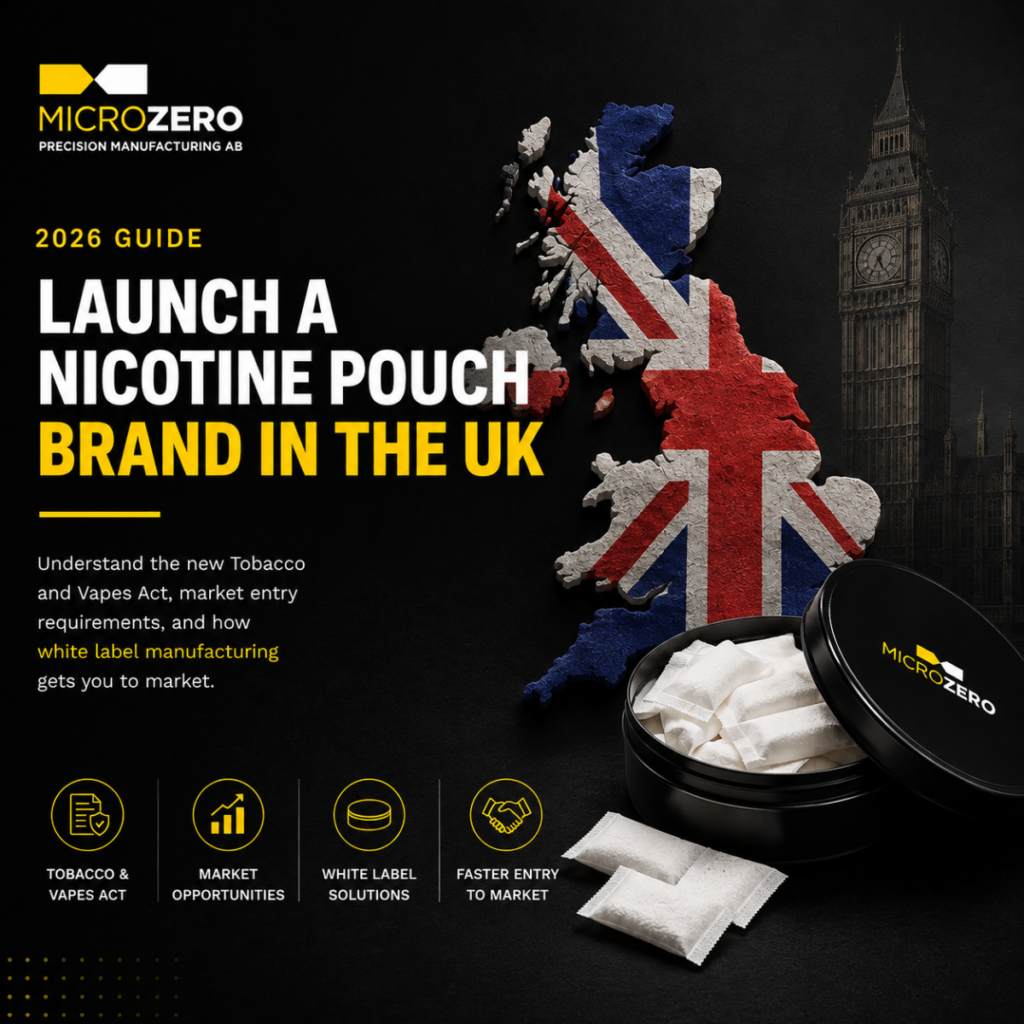
The UK is one of the most mature nicotine pouch markets in Europe, and it’s still growing. Part of that growth traces back to the ban on disposable vapes in June 2025, which pushed a meaningful number of former vape users toward pouches as a smoke free alternative. For anyone thinking about launching a brand, that combination of proven demand and an established retail channel makes the UK one of the more attractive markets to enter right now.
We’re Microzero AB, a Swedish manufacturer of white nicotine pouches, and we work with brand owners at exactly this stage: trying to understand what the UK market actually looks like, what the incoming regulation changes, and what it takes to get a product to shelf.
Why the UK Market Is Worth Entering Now
Unlike a lot of emerging markets, the UK doesn’t carry the regulatory uncertainty you’ll find elsewhere. Nicotine pouches are legal for adults, widely available through supermarkets, convenience stores, and online retailers, and the market has had years to mature. That maturity is exactly what makes it a strong target for a new brand. The demand is proven, the retail channels already exist, and consumers already understand the product, so a new brand isn’t starting from zero on education.
What’s Changing: The Tobacco and Vapes Act
The Tobacco and Vapes Act received royal assent in April 2026, and it’s the first time nicotine pouches have been brought into a dedicated regulatory framework in the UK, rather than sitting under general consumer product rules. A few of the practical changes brands should plan around:
An 18+ age of sale takes effect on 29 October 2026, along with a ban on giving away nicotine products for free, both online and in store.
A ban on advertising and sponsorship for nicotine products is scheduled for 1 June 2027.
The industry is also settling around a 20mg nicotine cap per pouch as new products come to market, ahead of any formal cap being set in secondary legislation.
None of this makes the UK a harder market to enter. A clearer regulatory framework actually makes it easier for a new brand to plan formulation, packaging, and marketing correctly from day one, instead of guessing at rules that might tighten later. Brands that build to the coming standard now, rather than adjusting after October, start with a real advantage.
The Competitive Landscape
The market today is largely held by a handful of names tied to the major tobacco groups, alongside a growing number of independent brands. It’s a useful market to study before launching, but it’s also less consolidated than cigarettes ever were. Consumers switch brands often to try new flavours or strengths, and that habit is exactly what gives a well built new product room to find its footing.
What It Takes to Launch: Formulation, Compliance, and a Manufacturing Partner
Building a new pouch brand from scratch, including formulation, quality control, and compliance documentation, is a heavy lift for most companies to take on alone. That’s why most brands work with an established manufacturer instead. We cover the full process, including MOQs, pricing, customization, and how to choose the right manufacturing partner, in our complete guide to white label nicotine pouches.
If you’re still mapping out what launching a brand actually involves, our step by step guide to starting a nicotine pouch brand covers planning, branding, and production from the very beginning.
Why Brands Choose a European Manufacturer
We manufacture white nicotine pouches at our facility in Gothenburg, Sweden, along with zero pouches, caffeine pouches, energy pouches, and nootropic formats, all with full white label customization. Working with a Swedish manufacturer gives a UK bound brand a few concrete advantages:
Consistent, documented quality control that already meets the higher bar the UK market and its retailers expect.
Full customization of nicotine strength, flavour profile, and pouch format through an in house flavour lab, so a new brand can differentiate from day one rather than launching a copy of what’s already on shelf.
Scalable production, so a brand can start with a smaller first run and grow into bulk and wholesale volumes without switching manufacturers later.
You can read more about how we produce them on our production page.
A Quick Look at the New Rules
| Change | Effective date | What it means for a new brand |
|---|---|---|
| 18+ age of sale | 29 October 2026 | Age verification needed online and in store from day one |
| Ban on free distribution | 29 October 2026 | No sampling giveaways as a launch tactic |
| Advertising and sponsorship ban | 1 June 2027 | Build organic and retail visibility rather than relying on paid brand campaigns |
| 20mg nicotine cap (industry norm) | Ongoing, ahead of formal legislation | Formulate to this ceiling now to avoid reformulating later |
Frequently Asked Questions
Is it still worth launching a nicotine pouch brand in the UK with new regulation coming?
Yes, if anything the timing works in a new brand’s favor. Launching to the coming standard now, rather than an older one that will need reworking later, avoids a costly relaunch down the line.
Do I need a UK based manufacturer to sell in the UK?
No. Plenty of UK market leaders are manufactured in Sweden and elsewhere in the EU and imported for UK retail. What matters is that the product meets UK requirements on nicotine strength, labeling, and (from October 2026) age verification at the point of sale.
How long does it typically take to launch a new pouch brand?
It varies by manufacturer and by how much customization is involved, but working with an established white label partner is significantly faster than developing formulation and production capability from scratch. Our complete guide to white label nicotine pouches covers the process and timeline in more detail.
What nicotine strength should a new UK brand launch at?
Most of the market sits within a range that keeps products broadly appealing to adult switchers from smoking or vaping, and many brands are aligning new formulations with the 20mg ceiling the industry has settled around ahead of formal regulation. The right strength ultimately depends on the target consumer and flavor profile.
Can flavour still be a differentiator once advertising restrictions come in?
Yes, arguably more so. With advertising and sponsorship limited from mid 2027, product differentiation through flavour range, format, and in store presence becomes more important relative to marketing spend.
Get in Touch
If you’re building a brand for the UK market, or planning ahead for the October 2026 rule changes, get in touch with our team and we can talk through formulation, compliance, and minimum order quantities for your first production run.
This article is for general market information only and isn’t legal advice. Brands should confirm current regulatory requirements with local legal counsel before entering any new market.