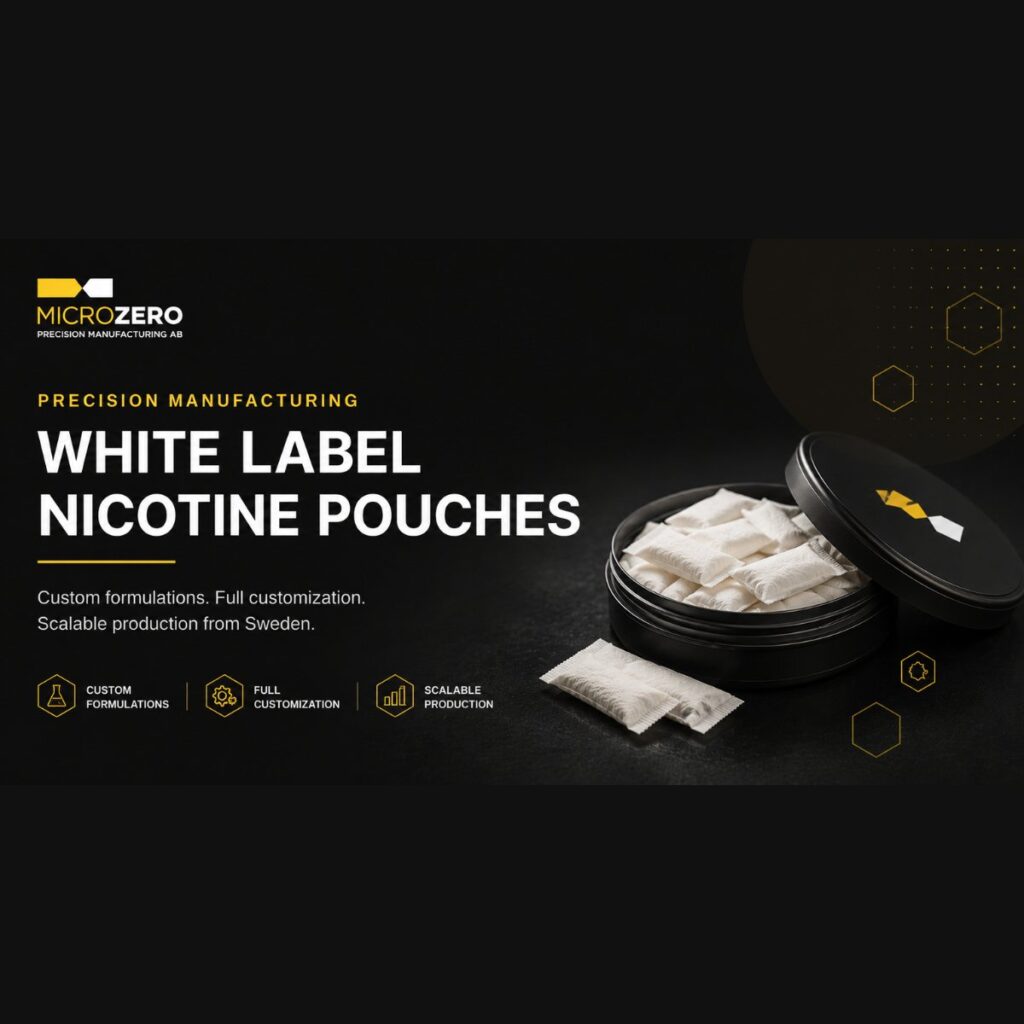
Everything you need to know about white label nicotine pouch manufacturing, product customization, production, regulations, and choosing the right manufacturing partner.
Introduction
The global nicotine pouch market has grown at a remarkable pace over the past few years. It shows no sign of slowing down. As more consumers move away from traditional tobacco products, they look for tobacco-free, smoke-free alternatives. As a result, nicotine pouches have become one of the fastest-growing categories in the nicotine industry. For entrepreneurs, distributors, and established brands alike, this growth has created a genuine window of opportunity. White label nicotine pouches are the fastest, most cost-effective way to step through it.
Launching a nicotine pouch brand no longer requires building a factory, sourcing raw materials from scratch, or spending years developing manufacturing expertise. Instead, businesses can partner with an experienced white label manufacturer. From there, you can select from proven formulations and packaging options, add your own branding, and bring a market-ready product to shelves in a matter of months rather than years.
However, not all white label projects — and not all manufacturers — are created equal. The decisions you make early on will shape your product’s market position, your margins, and ultimately your brand’s success. These include nicotine strength, flavor profile, packaging materials, and MOQ.
In this guide, we’ll walk through how white label nicotine pouch manufacturing works. We’ll also cover what customization options are realistically available, how pricing and MOQ are determined, and what regulations you need to be aware of. Finally, and perhaps most importantly, we’ll look at how to evaluate and choose a manufacturing partner you can build a long-term business with.
Whether you’re a first-time entrepreneur exploring the category or an established company looking to expand your product range, this guide will give you a clear, practical roadmap.
What Are White Label Nicotine Pouches?
White label nicotine pouches are ready-to-market nicotine products. They are manufactured by an established producer and then sold under a different company’s brand name. The manufacturer handles the formulation, production, and often the packaging development. Meanwhile, the client — your brand — owns the marketing, distribution, and customer relationship.
This is fundamentally different from developing a brand-new product from the ground up. Rather than spending years perfecting a formulation, sourcing nicotine and flavoring ingredients, and validating production processes, a white label approach lets you leverage manufacturing expertise that already exists. Furthermore, that expertise is already proven in the market.
A typical white label project includes:
- Custom branding and logo placement
- Custom packaging design (cans, pouches, or tins)
- Flavor selection from an existing portfolio, or lightly adjusted variations
- Nicotine strength selection
- Label design and regulatory-compliant artwork
- Regulatory documentation and compliance support
- Commercial-scale production and fulfillment
As a result, you get a significantly shorter development timeline and a lower barrier to entry. On top of that, your product is built on a manufacturing process that has already been tested and refined — while still carrying your brand identity on the shelf.
How White Label Nicotine Pouches Are Manufactured
While every manufacturer structures their process slightly differently, most white label nicotine pouch projects follow a similar sequence of stages.
1. Initial Consultation
This is where the manufacturer gets to know your business. Expect questions about your target market, your positioning (premium, value, lifestyle-focused), your expected order volumes, and your timeline. This stage sets the foundation for everything that follows. In fact, the more clearly you can articulate your goals here, the smoother the rest of the process will be.
2. Product Selection
Next, you’ll choose from the manufacturer’s available formats: pouch size, nicotine strength range, moisture level, and flavor categories. Many manufacturers offer a base portfolio of “ready-to-brand” flavors that require no additional development. This is the fastest route to market.
3. Brand Development
This is where your packaging, label artwork, can design, and overall product positioning come together. A good manufacturer will guide you through what’s technically possible with their packaging lines. This way, you won’t end up designing something that can’t actually be produced.
4. Sampling
Before any commercial production begins, you should receive physical samples. This step is non-negotiable — a photo or a spec sheet is not a substitute for holding, opening, and tasting the actual product. Sampling is also when small adjustments to flavor intensity, moisture, or pouch texture are typically made. At Microzero AB, for example, sample products are provided as a standard part of every white label project, so you can evaluate the exact formulation before committing to a full production run.
5. Production
Once samples are approved, the manufacturer moves into commercial-scale production under quality control procedures. Batch consistency, ingredient verification, and process monitoring should all be happening at this stage, even if you don’t see it directly.
6. Packaging & Shipping
Finished products are packaged, inspected, and prepared for shipment. Depending on your market, this may also include export documentation, customs paperwork, and compliance labeling for the destination country.
Understanding this sequence matters. It helps you ask the right questions at the right time, and it helps you spot a manufacturer who is skipping steps to save time.
White Label vs Private Label
The terms “white label” and “private label” are often used interchangeably. However, they describe two genuinely different approaches. Choosing the right one has a real impact on your timeline, budget, and long-term product ownership.
White Label
- Faster time to launch
- Built on existing, proven formulations
- Lower development costs
- Manufacturing process is already validated
- Ideal for startups and first-time brand launches
Private Label
- Greater product customization
- Proprietary, brand-exclusive formulations
- Unique recipes developed specifically for you
- Higher development costs
- Longer development timelines
In practice, many companies start with a white label product to get to market quickly and validate demand. Later, they gradually transition toward more customized private label formulations once the brand has traction and the volumes justify the additional development investment. Ultimately, there’s no wrong choice here — it depends on your budget, your timeline, and how differentiated you need your product to be from day one.
Benefits of White Label Manufacturing
Choosing a white label approach comes with a number of concrete advantages, especially for brands entering the category for the first time.
Faster time to market. Launching a brand can realistically take a matter of months rather than the years required to develop a product from scratch.
Lower investment. There’s no need to build or lease a production facility, install specialized equipment, or hire a production team.
Reduced risk. Since the manufacturing process has already been validated and optimized by the manufacturer, you’re not the one absorbing the cost of early-stage production mistakes.
Professional-grade quality. Experienced manufacturers maintain consistent production standards across every batch, which protects your brand reputation from day one.
Scalability. As your brand grows, production volumes can scale with you — you’re not locked into the capacity of a single small production run.
Product Customization
One of the most common misconceptions about white label manufacturing is that it means a generic, one-size-fits-all product. In reality, however, modern white label manufacturing offers considerably more flexibility than most first-time brand owners expect.
Depending on the manufacturer’s capabilities, customization may include:
- Nicotine strength
- Flavor profile
- Pouch size and format
- Moisture level
- Packaging design and materials
- Branding and logo placement
- Can/tin design
- Label artwork and finish
The extent of customization available to you will depend on the manufacturer’s equipment, minimum order quantities, and how much lead time you’re able to give them. As a general rule, the more customization you request, the higher the MOQ and the longer the development timeline. Therefore, it’s worth being deliberate about which elements matter most to your brand and which can start closer to the manufacturer’s existing offering. At Microzero AB, this range spans several product formats, including white nicotine pouches, tobacco-free zero pouches, and function-focused options such as nootropic pouches, energy pouches, and caffeine pouches.
Nicotine Strengths
Manufacturers typically offer a range of nicotine strengths to serve different markets and consumer preferences. Common strength options include:
- 3 mg
- 4 mg
- 6 mg
- 8 mg
- 10 mg
- 12 mg
- 14 mg
- 16 mg
- 20 mg
Which strengths are available — and which are permitted — will vary depending on the regulations of your target market and the preferences of your intended customer base. Generally, markets with more experienced nicotine pouch consumers skew toward higher strengths. In contrast, markets that are newer to the category, or that have stricter regulatory limits, tend to favor lower strengths. This is worth researching carefully before finalizing your product range, since offering the wrong strength lineup for your market can quietly limit your sales.
Flavour Development
Flavor is one of the single biggest differentiators in a crowded nicotine pouch market, and it’s often the first thing a customer notices when trying a new brand.
Popular flavor categories include:
- Mint, spearmint, and peppermint
- Citrus
- Berry
- Tropical fruit
- Coffee
- Cola
- Energy-drink-inspired flavors, such as those used in our energy pouches
Most manufacturers offer a portfolio of existing, ready-to-brand flavors. These are the fastest and most cost-effective option, since no additional development work is needed. However, if you want something more distinctive, many manufacturers will also support custom flavor development, adjusting sweetness, intensity, and aroma to create something closer to your brand’s identity. Naturally, this takes longer and typically comes with a higher MOQ, since it requires dedicated formulation and testing time.
A good manufacturer will be transparent about which flavors are “off the shelf” and which require development — be wary of any partner who isn’t clear about this distinction upfront. Microzero AB, for instance, can develop virtually any flavor a brand requests, rather than limiting clients to a fixed catalog, which gives brands considerably more room to create a genuinely distinctive product.
Packaging Options
Packaging is very often the first physical touchpoint a customer has with your brand. In a category where products are frequently compared side by side on a shelf or in a photo, it matters enormously.
Common packaging options include:
- Plastic cans in various sizes
- Matte finishes
- Gloss finishes
- Soft-touch coatings
- Metallic finishes
- Sustainable or recyclable packaging materials
- Child-resistant packaging, where required by regulation
Beyond the visual finish, it’s worth considering practical factors too: how the can seals, how easy it is to open and reclose, and whether the packaging is genuinely compliant with the regulations of every market you plan to sell in. Child-resistant closures, for instance, are a legal requirement in a growing number of jurisdictions. Ultimately, high-quality, well-thought-through packaging does more than look good — it builds the kind of consumer trust that turns a first-time buyer into a repeat customer.
MOQ for White Label Nicotine Pouches
Almost every manufacturer will set a Minimum Order Quantity for a white label production run — the smallest batch size they’re willing to produce.
MOQ is shaped by several factors, including:
- The product format and pouch type
- The number of flavors ordered simultaneously
- The complexity of the packaging
- Printing and label requirements
- Production line setup and changeover time
MOQ is one of the very first things to discuss with a prospective manufacturer, and it’s worth discussing honestly and early. After all, there’s little value in falling in love with a packaging concept or flavor lineup only to discover the MOQ doesn’t align with your budget or your realistic first-year sales volume. Many manufacturers are willing to negotiate a lower MOQ for a first order, with the expectation of scaling up on repeat orders as the relationship develops. It’s always worth asking.
Production Timeline
While exact timelines vary between manufacturers and project complexity, a typical white label production timeline includes:
- Initial product consultation
- Product and flavor selection
- Packaging and label development
- Sample production and approval
- Production scheduling
- Commercial manufacturing
- Quality inspection
- Packaging and shipping
Depending on how much customization is involved, this process can take anywhere from a few weeks for an off-the-shelf flavor with minimal packaging changes, to several months for a fully custom flavor and packaging development. Working with an experienced manufacturer — one who communicates clearly and sets realistic expectations from the outset — is the single biggest factor in avoiding unnecessary delays. Additionally, if a manufacturer promises an unusually fast timeline for a fully custom project, it’s worth asking exactly which steps they’re compressing to hit that date.
Pricing Factors for White Label Nicotine Pouches
There’s no single flat price for white label nicotine pouches — the final unit cost depends on a combination of variables, including:
- Order volume
- Nicotine strength
- Ingredient specifications
- Flavor complexity (off-the-shelf versus custom development)
- Packaging specifications and materials
- Label printing method and finish
- Shipping destination and logistics
- Regulatory and compliance requirements specific to your target market
As a general rule, higher production volumes bring down the unit cost, since fixed setup costs are spread across more units. It’s worth asking any prospective manufacturer for a transparent cost breakdown across a few different volume tiers. This way, you can see exactly how your margins shift as your order size grows, which also makes it much easier to plan your retail pricing strategy from the outset.
Quality Control
Consistency is everything when producing white label nicotine pouches. A customer who loves your product on their first purchase needs to get exactly the same experience on their tenth. Otherwise, inconsistent quality is one of the fastest ways to lose a customer’s trust permanently.
A reliable manufacturing partner should have quality control measures built into every stage of production, including:
- Raw material inspection on arrival
- Ingredient verification against specification
- In-process production monitoring
- Laboratory testing of finished product
- Packaging inspection before shipment
- Batch traceability, so any issue can be tracked back to its source
- Final product review before release
Don’t be afraid to ask a manufacturer directly about their quality control process, request documentation, or ask whether third-party lab testing is available. A manufacturer who is confident in their quality systems will be happy to walk you through them in detail.
Regulations
Regulations for white label nicotine pouches vary significantly between countries and regions. Moreover, they continue to evolve as the category grows and attracts more regulatory attention. Before launching in any market, it’s essential to understand and verify:
- Which ingredients are permitted
- Labeling and warning requirements
- Packaging regulations, including child-resistant packaging where mandated
- Maximum permitted nicotine strengths
- Import requirements for your destination market
- Export documentation required from the country of manufacture
Regulatory requirements are one of the areas where working with an experienced manufacturer genuinely pays off. A manufacturer who already exports to your target market will typically have the documentation, labeling templates, and compliance knowledge already in place. That said, regulations are ultimately your responsibility as the brand owner. So, it’s worth verifying independently rather than relying solely on a manufacturer’s word, especially the first time you enter a new market.
How to Choose a White Label Nicotine Pouches Manufacturer
Choosing the right manufacturing partner is arguably the single most important decision in this entire process. In fact, it’s more important than flavor selection, packaging design, or even your initial pricing strategy. A strong manufacturing relationship can grow with your brand for years; a poor one can quietly undermine everything else you build.
When evaluating potential manufacturers, consider:
- Industry experience — how long have they been producing nicotine pouches specifically, rather than adjacent products?
- Manufacturing capacity — can they scale with you as your order volumes grow?
- Product quality — request samples and evaluate them independently, ideally against your current benchmark products.
- Certifications — what quality and safety certifications does their facility hold?
- Quality assurance systems — are there documented, verifiable QC processes at every production stage?
- Communication — are they responsive, clear, and proactive, or do you have to chase every update?
- Product customization — how flexible are they, realistically, beyond their off-the-shelf catalog?
- Lead times — are their quoted timelines realistic and consistently met?
- Customer support — is there a dedicated point of contact for your account?
- Export experience — do they have a track record of shipping compliantly to your specific target markets?
A genuinely good manufacturing partner will offer both technical expertise and consistent, transparent communication. After all, they’ll be just as interested in your brand’s long-term success as you are, because a growing brand means a growing, stable order volume for them too.
Frequently Asked Questions
What are white label nicotine pouches? White label nicotine pouches are products manufactured by one company and sold under a different company’s own brand name and packaging.
Can I create my own nicotine pouch brand? Yes. White label manufacturing allows businesses of almost any size to launch their own branded nicotine pouch products without owning or operating a production facility.
How long does production take? Timelines vary depending on the level of product customization, flavor development, and packaging complexity involved, but a straightforward project with off-the-shelf flavors can move considerably faster than a fully custom development.
What is the minimum order quantity? MOQ differs between manufacturers and depends on the specific product, flavor, and packaging specifications you choose. It’s one of the first things to clarify in an initial consultation.
Can I customize flavors and packaging? Most manufacturers offer meaningful customization across flavors, nicotine strengths, packaging materials, and branding — though the degree of customization available typically affects both MOQ and lead time.
How do I choose the right manufacturer? Look for a manufacturer with genuine industry experience, documented quality control processes, flexible customization options, transparent and responsive communication, and a proven track record of exporting to your target markets.
Conclusion
White label nicotine pouches offer an efficient, lower-risk, and considerably faster path for businesses looking to enter one of the fastest-growing categories in the nicotine industry. By partnering with an experienced manufacturer, you can focus your time and resources on what matters most for your brand: positioning, marketing, and building genuine customer relationships. Meanwhile, you can rely on a proven partner for formulation, production, and quality assurance.
Whether this is your first nicotine pouch brand or an expansion of an existing product portfolio, the manufacturing partner you choose will shape nearly every part of your journey from here. Ultimately, taking the time to evaluate that decision properly, rather than rushing toward the first quote you receive, is the single best investment you can make before you launch.