
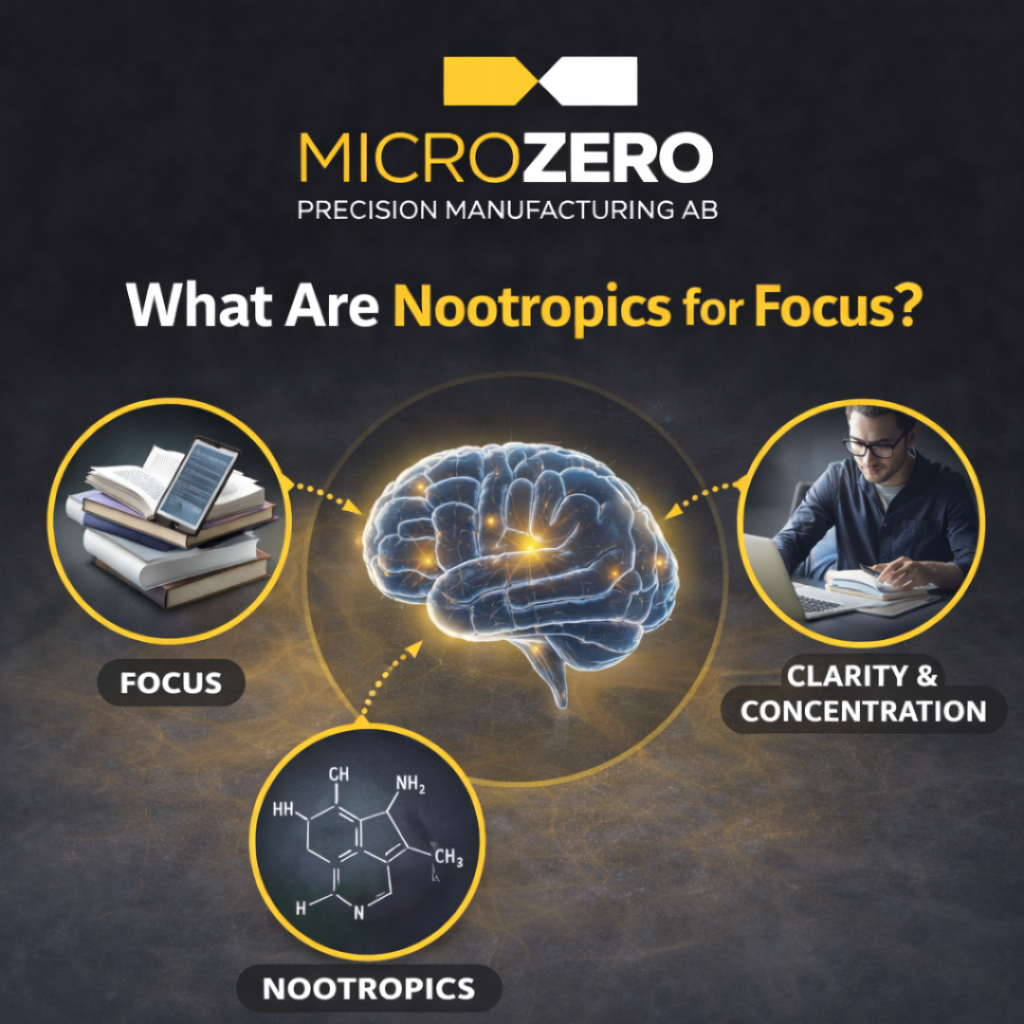
Maintaining focus in a world full of constant notifications, information overload, and cognitive demands can be challenging. For this reason, interest in nootropics for focus has grown steadily over the past decade. Nootropics are often discussed in the context of mental performance, clarity, and sustained concentration, especially in academic, professional, and creative settings.
This article explores how nootropics are used to support focus, mental clarity, and concentration, what mechanisms are typically involved, and how they fit into a broader cognitive wellness routine.
What Are Nootropics?
Nootropics is a broad term used to describe substances that are associated with cognitive functions such as memory, attention, alertness, and mental clarity. The concept was originally introduced in the 1970s to describe compounds that support brain function without causing significant negative effects.
Today, nootropics can include naturally occurring compounds, plant-derived extracts, amino acids, and other nutrients that interact with the brain’s chemistry in different ways. Importantly, nootropics are not stimulants in the traditional sense; their focus is typically on supporting cognitive processes rather than forcing short-term stimulation.
Focus, Mental Clarity, and Concentration Explained
Although often used interchangeably, focus, mental clarity, and concentration refer to slightly different cognitive states:
- Focus is the ability to direct attention toward a specific task or thought.
- Mental clarity describes a state of reduced cognitive “noise,” where thoughts feel organized and decision-making feels easier.
- Concentration refers to the ability to sustain focus over time without mental fatigue.
Effective cognitive support aims to balance all three rather than maximize one at the expense of the others.
How Nootropics Support Focus
Nootropics for focus are commonly used to support attention by working with the brain’s natural systems. While individual compounds differ, their effects generally relate to a few core mechanisms.
Neurotransmitter Support
Many nootropics interact with neurotransmitters such as acetylcholine, dopamine, or glutamate. These chemical messengers play a central role in attention, learning, and motivation. Supporting balanced neurotransmitter activity may help improve the brain’s ability to prioritize information and maintain attention.
Mental Energy and Alertness
Rather than creating spikes in stimulation, some nootropic compounds are associated with smoother mental energy. This can be especially relevant for tasks that require prolonged concentration, such as studying, problem-solving, or detailed analytical work.
Stress and Cognitive Load
Mental stress can significantly reduce focus and clarity. Certain nootropics are studied for their potential role in stress regulation, which may indirectly support concentration by reducing cognitive overload and mental fatigue.
Nootropics and Mental Clarity
Mental clarity is often described as the absence of brain fog. This state can be influenced by sleep quality, hydration, nutrition, and stress levels. Nootropics are sometimes used as part of a routine aimed at supporting clearer thinking by:
- Supporting efficient neural communication
- Promoting balanced cognitive arousal
- Reducing perceived mental fatigue
Clear thinking is not necessarily about thinking faster, but about thinking more efficiently and with fewer distractions.
Concentration Over Time
Sustained concentration is one of the most challenging aspects of cognitive performance. Many people experience strong focus initially, followed by rapid mental fatigue. Nootropics for focus are often explored for their potential to support endurance in cognitive tasks rather than short bursts of attention.
This makes them particularly relevant for activities such as long meetings, extended study sessions, or creative work that requires deep focus over time.
Forms and Use Cases
Nootropics are used in various formats depending on lifestyle preferences and use cases. Some individuals prefer integrating them into daily routines, while others use them situationally during periods of high cognitive demand.
One modern format that has gained attention is nootropic pouches. These pouches are designed to deliver nootropic compounds in a standardized and consistent format, with careful consideration given to composition, dosage, and usability. For a deeper explanation of how nootropic pouches are formulated and structured, see this overview of nootropic pouches.
Nootropics as Part of a Cognitive Routine
It is important to view nootropics as a complement rather than a replacement for foundational cognitive habits. Focus, clarity, and concentration are strongly influenced by:
- Consistent sleep patterns
- Balanced nutrition
- Regular physical activity
- Stress management
Nootropics are typically explored as part of a broader approach to cognitive well-being, not as a standalone solution.
Individual Variation and Expectations
Cognitive responses vary significantly between individuals. What supports focus for one person may feel subtle or different for another. Factors such as baseline stress levels, sleep quality, and cognitive workload all influence how nootropics are experienced.
For this reason, discussions around nootropics for focus often emphasize realistic expectations and personal awareness rather than universal outcomes.
Final Thoughts
Interest in nootropics continues to grow as more people seek ways to support focus, mental clarity, and sustained concentration in demanding environments. By working with the brain’s natural processes, nootropics are commonly explored for their potential role in cognitive support without relying on intense stimulation.
Understanding how these compounds are used and how they fit into a balanced lifestyle provides a clearer perspective on their role in modern cognitive wellness.